Essay
Finding Your Clock Speed

Disclaimer: This article reflects my personal views and independent perspectives. I am not affiliated with or employed by Phoenix Court, and the opinions expressed here are entirely my own.
For more than 20 years, I have been building, advising and investing in founders across very different industries, business models and markets. I have worked with highly regulated healthcare startups, fast-paced social app companies, and scientific ventures that require years of research before they can be spun-out and commercialised. Working across such a diverse portfolio has raised many questions about the differences in building these ventures, their time to market, and what makes these companies fit for a venture investment.
Some of the companies I worked with struggled to raise venture funding. They simply did not fit the classic VC model and their expectations for growth timeline: a blitzscaling venture with the potential to exit within 7–10 years of founding and deliver a 10x return to the fund. Some of them required more patient capital, others required 5 years of research before you could reach a reasonable TRL level.
Some of the biggest challenges I encountered were with hardware companies and ventures with unique financing models involving significant CAPEX requirements. Another challenging category was academic spinouts, whether in energy, defence or healthcare. For many VCs, the risks associated with scientific validation and proof of concept were simply outside their investment thesis.
The Phoenix Court's Three Clock Speeds framework fits to those different innovation and investment use cases, of those ventures who might be misfits to the classic VC model. I found it a healthy approach to thinking about venture investing and portfolio construction. It recognises that companies come in different forms, sizes, business models and, importantly, speeds. It validates the idea that there is a place in venture for investing in hardware, software and scientific ventures, particularly for long-term, patient investors. It is a mental model on how venture could contribute to economic growth strategically and not only through hyper scaling businesses.
The Three Clock Speeds: A Different Way to Think About Innovation
The Three Clock Speeds investment philosophy was recently introduced by Phoenix Court, one of Europe's leading venture capital firms, based in London's King's Cross and founded by Saul and Robin Klein.
The framework reflects a deeper understanding of how venture capital has evolved. The companies being built today and backed by VCs are no longer exclusively exponential-growth software businesses expected to reach an exit quickly. They come in different forms, operate under different business models and, importantly, move at different speeds.
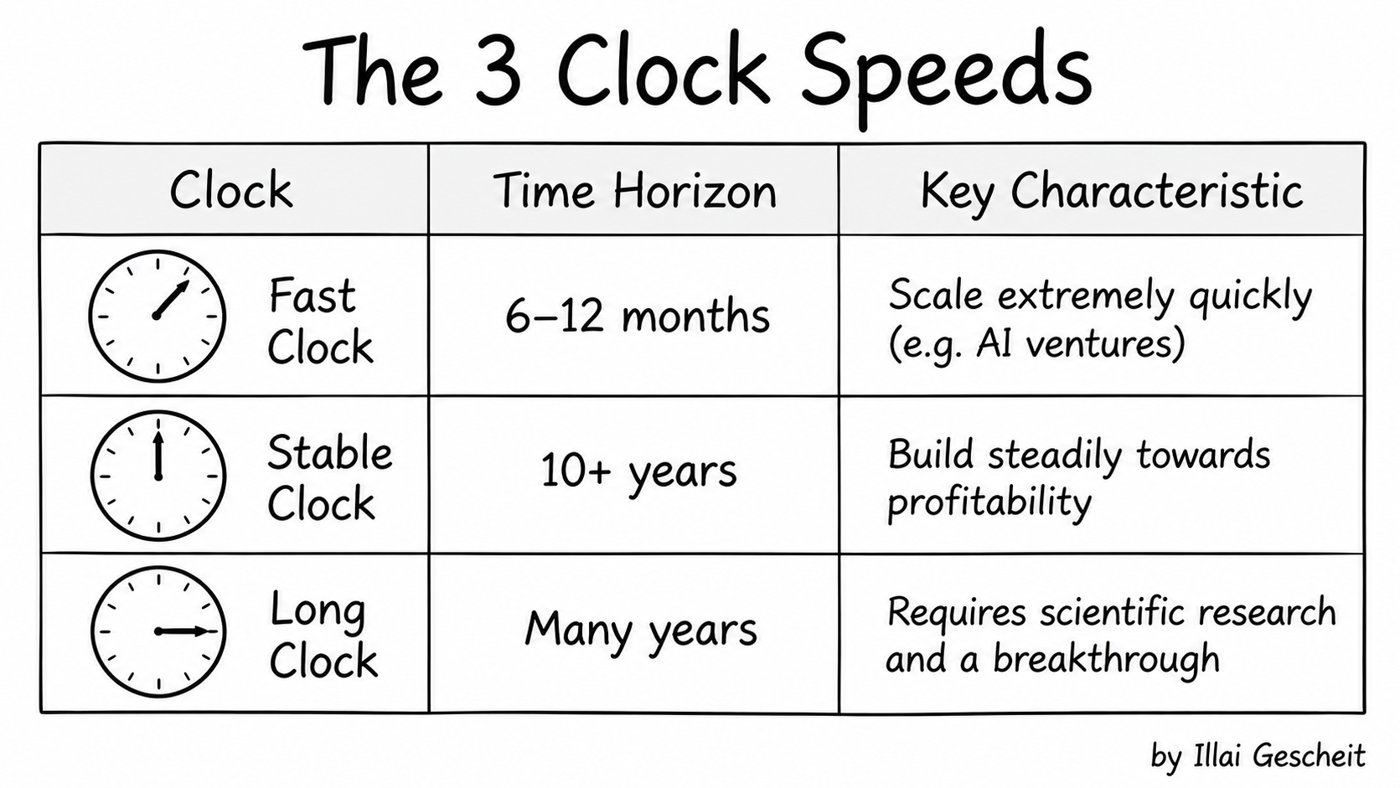
Phoenix Court's investment philosophy recognises three types of venture time spaces:
- The Fast Clock: Companies such as AI ventures that can scale extremely quickly, sometimes reaching incredible levels of scale within months (6-12 months).
- The Stable Clock: Companies built over a longer period, sometimes a decade or more, scaling steadily and robustly towards profitability (10+ years).
- The Long Clock: Companies that require years of scientific research and experimentation, and sometimes a scientific breakthrough, before they can reach commercialisation.
I listened to a conversation between Ziv Reichert, Partner at the Phoenix Court and Anton Poletaev, Co-Founder at Microagi discussing how Microagi operates in the Fast Clock sphere, reportedly reaching $100 million ARR in just six months in an extremely challenging field: robotics and the physical world, particularly industrial environments.
In another conversation, Oliver Prill, CEO of Tide, spoke with Robin Klein about building a company over ten years, raising capital through three different Phoenix Court funds and compounding its value through major events such as COVID-19, geopolitical shifts and economic uncertainty and continuing to grow steadily.
Finally, some fascinating examples of the Long Clock include Katie King's work on building the future of drug manufacturing in space, with the potential to transform the efficiency and speed at which medicines are developed to cure diseases.
Phoenix Court does not suggest that one clock speed is preferable to another. Instead, from a portfolio construction perspective, it aims to diversify investments across all three clocks, adopting a patient, long-term investment strategy. This approach considers not only different types of businesses but very different personalities of venture founders from young ambitious founders to experienced industry experts that disrupts markets they operated in for decades.
Reflecting on this framework and my own experience working with companies across diverse industries and business models, I believe there are four critical pitfalls that founders and CEOs need to be aware of. These are challenges I have repeatedly encountered, and they can make or break a venture.
Looking at these risks through the lens of the Three Clock Speeds can help bring greater clarity to some of the most important decisions founders and investors face and help to address those challenges early.
Building at the wrong speed
When you don't have clarity about the type of business and company you want to build. I worked closely with a CEO who had been building his company for more than ten years as a hardware business. The company had a software system that controlled all its devices, but by definition, it was a hardware company, built around sensors and monitoring devices. Around 90% of its resources, talent, time and effort went into building, assembling and selling hardware.
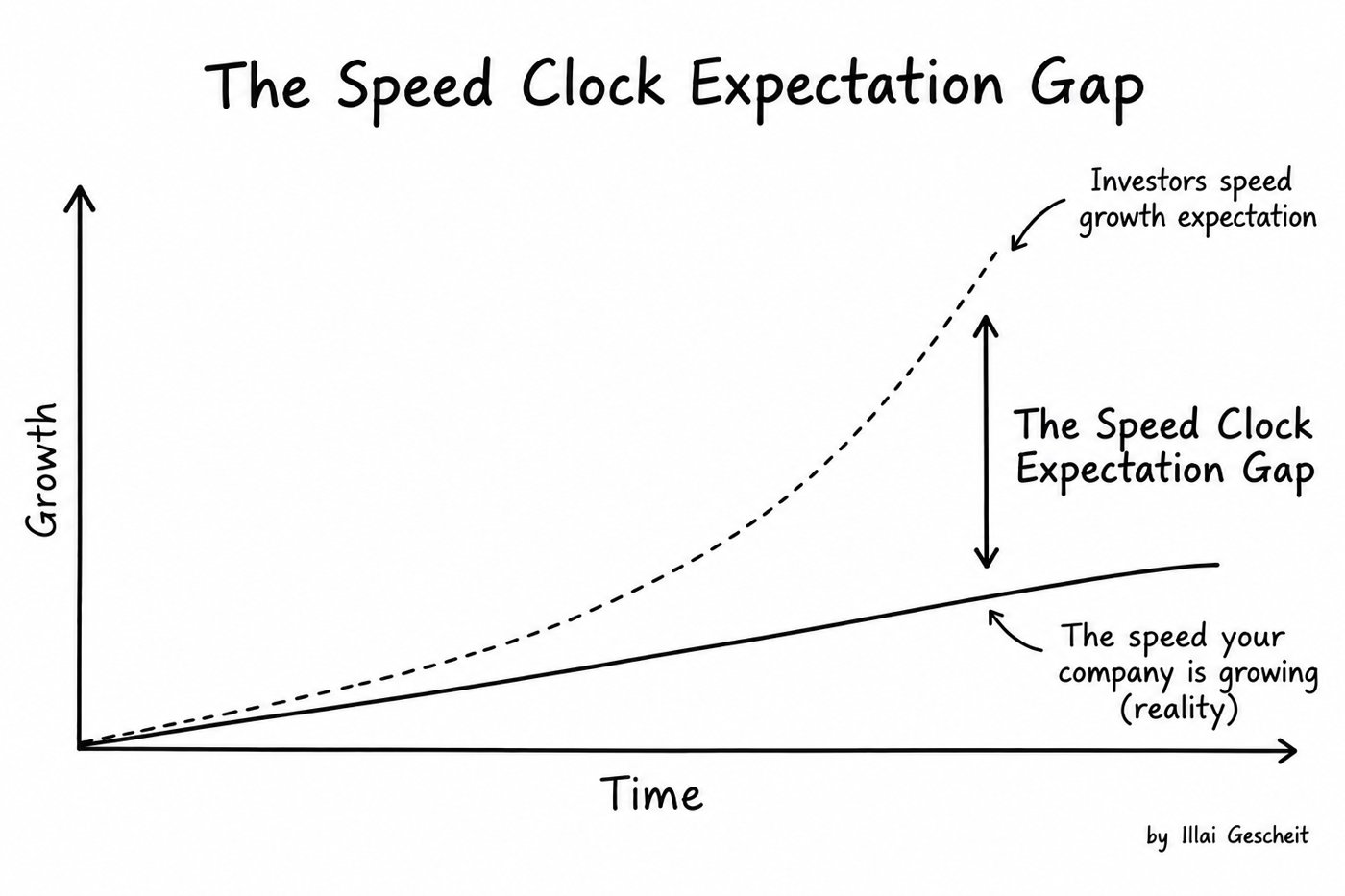
The company was also targeting a very traditional industry, which was relatively reluctant to change and adopt new innovations. The CEO and other investors were increasingly frustrated with the pace of growth and questioned why the company wasn't scaling as quickly as they had hoped. The aspired ambition was to build a Fast Clock company, but the reality of the business was much closer to the Stable Clock.
I remember having some tough conversations about the company's identity. My view was that if we wanted to grow faster, we needed to pivot towards prioritizing the development of the software and monitoring platform only and shift resources internally. This meant putting more energy, resources and time into hiring great software engineers if we wanted to attract VC money and achieve exponential growth.
The alternative was to keep the existing business model and structure, but adjust expectations of the management and board around the growth timeline and, importantly, the type of investors we needed to attract that will accept and be comfortable with stable growth.
Looking back at this case through the Three Clock Speeds framework, I believe that building a company at the wrong speed while having an ambition or expectations for this business to move at a different speed creates significant frustration for founders, teams and investors alike - it could break that venture and the spirit of the team.
When building a company, founders need to think deeply about whether they are building at the right speed that fits the type of product, technology and market they operate in. More importantly, they need to ask themselves a fundamental question: What is our identity as a company? Building at a certain speed defines the identity of your business and who you are as a founder.
The False Clock: When Investor Expectations Don't Match Venture Reality
When you are being pushed by investors to build at a different clock speed. I have seen this happen both as an investor in corporate venture capital units and through my work with founders and global corporations. Founders can be pushed to build their companies at a different speed from the one their business actually requires and that will lead them to success.
My first example is quite common when you have a strategic corporate investor on your cap table: a corporation might impose its own clock on an early-stage and even growth stage, fast-moving startup. One of the companies I spun out of a large corporation was a B2C climate intelligence business. We operated very lean, with a subscription-based business model. We built a simple MVP and wanted to launch quickly, test the market, run customer experiments and iterate. Our team had developed a simple yet robust authentication and registration system to start acquiring customers.
However, when we announced our planned soft launch date internally, we were asked to change our launch plans and conduct three months of penetration testing, carried out by IBM and would cost tens of thousands of dollars. This would postpone the launch significantly and, more importantly, delay the learning process and our customer discovery process. For a company operating on the Fast Clock, three months was a significant amount of time that would end up with not hitting milestones and wasting our capital and energy. Essentially, by imposing corporate tools and frameworks, the corporation was imposing a clock speed that did not fit our business and the speed which we targeted.
I have also seen this happen when founders take investment from the wrong investors. A PhD student I mentored was working on a new AI venture in drug discovery. Her work required long research cycles, partnerships with laboratories and government institutions, and navigating complex negotiations with the university technology transfer office, intellectual property submissions, grants and access to laboratory resources.
She received her first angel investment from a SaaS founder who had successfully exited his own company. My conversations with this scientist-founder were mostly about helping her manage the pressure and expectations coming from her first angel investor. The investor was pushing her to develop a business model and operate at the speed of a SaaS company, while she was building a venture that clearly belonged to the Long Clock. It required a completely different structure, talent, funding model and approach to building a scientific venture.
This case demonstrates why I believe founders should be extremely thoughtful about finding investors and VCs who are aligned with the clock speed at which their company needs to operate. It also requires investors the humility and open mind to unlearn what they know, maybe on the speed in which they operated other companies and be clear that in order to succeed they might need to adapt to a different speed clock. Aligning on that when you sign your term sheet will remove pressure moving forward in the partnership.
Diversifying Your Clock Speeds: When One Speed Is Not Enough
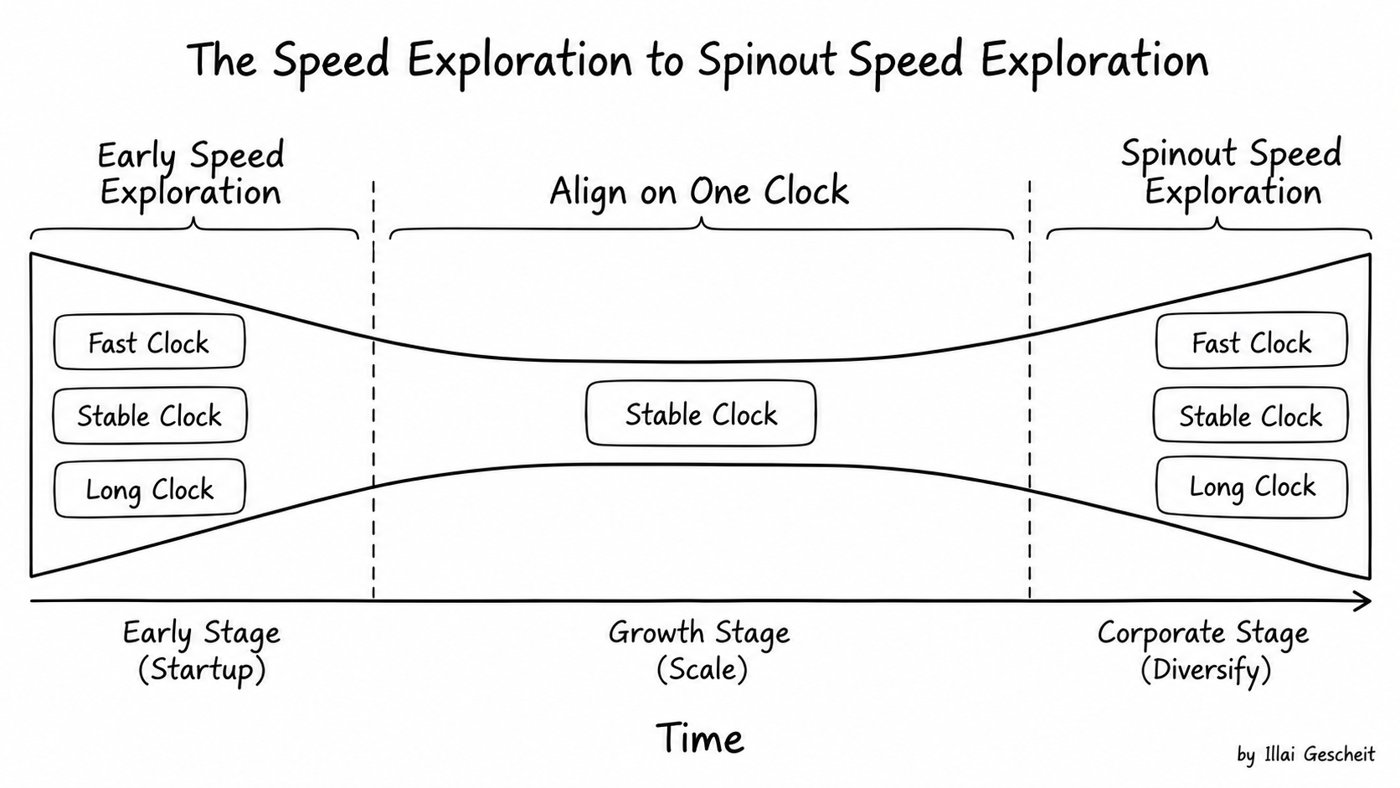
When you are the CEO of an established company, diversifying the clock speeds at which you build could give you a competitive edge. I have built two corporate venturing units for large, traditional corporations. Unlike startups, the corporations I worked with had robust business models, large global customer bases and established revenue streams.
Once a company reaches corporate scale, it starts operating at a very different speed from a startup company, and it should. As companies grow, they build more processes, structures and layers of hierarchy that lead to the speed of innovation to slow down - the same business decision that you would make on the day, might take months, and three committees to approve. This has also advantages when we try to reduce risk and maintain a corporate long-term objective.
I sometimes feel that those CEOs are not fully conscious of the fact that they have graduated from building at one clock speed to operating at another. They are reducing speed while the markets and industry move at a different speed.
My role in those companies was to build the mechanism and the structures that will allow them to diversify their clock speeds. The venturing units we built enabled those corporations to invest in companies that move at fast clock speeds, and sometimes in long clock speeds. They included partnerships and piloting with those startups and the toughest part was venture building, which means that I worked with teams internally to form new companies and sometimes spin them out of the company into venture backable startups.
The idea was not to change the speed in which the mothership is moving, but to diversify. Taking minority shares in a high growth company, enables a corporation to keep up and have insights to new markets, piloting pushes their own slower clock to accelerate in certain areas. The most challenging part is changing the mindsets of intrapreneurs who are building ventures from within to build at one speed while their environment is moving at a different one.
Just like Phoenix Court's investment portfolio, corporations should consider building a portfolio of products, services and ventures across different clock speeds to keep exploring new forms of innovation. Not everything will succeed. But a diversified portfolio of innovation initiatives can create opportunities, generate new learnings and help businesses maintain their competitive edge, regardless of the industry in which they operate.
Two Founders, Two Clocks
When co-founders are building the same company at different clock speeds. Some of the most challenging situations I have worked through with founders involved co-founders who were simply not aligned. This is true whether a founding team has two co-founders or seven, as we increasingly see in some AI labs and scientific ventures.
Keeping co-founders aligned is hard, continuous work. It requires attention, commitment and deliberate mechanisms to make sure everyone is moving in the same direction. Co-founders need to align on business and product strategy, hiring plans, valuations, fundraising activities and, most importantly, their company values and culture. Through the lens of Phoenix Court's Three Clock Speeds framework, I would add another important dimension: they also need to align on the speed at which they are building the company and the clock they are operating on.
I worked with one company almost ten years ago that had raised more than $70 million. From the outside, the feeling was that the company was moving fast. However, when I spoke with people across the team, reality was different. It seemed that the two co-founders had developed two different roadmaps and, essentially, were building two different teams, each moving the company at a different speed.
The underlying problem was a lack of healthy communication between the co-founders. They also fundamentally disagreed on some of the core elements of building their business. Disagreements are inevitable, but founders need the right mechanisms to address them. Boards, advisors and deliberate governance structures can help create the conditions for better communication and alignment among co-founders.
Having two founders operating at two different clock speeds meant the company was not moving as one and ultimately, this was hurting the business.
More recently, I have been working with two really strong co-founders building an ambitious AI company. They were extremely open with me from day one about the fact that they felt they were operating at two different speeds. One felt they were running a marathon, while the other felt they were running a sprint. What I found particularly interesting was that both were conscious of their own founder clock speed but also of the clock speeds of each other. By recognising this difference and having some difficult but constructive conversations, we have been continuously working to align their pace and make sure they move forward as one.